I was checking in on a bunch of internet stuff this morning when I realized I had been CREEPED. LURKED. PERVED ON.
This was not a normal creeping, like a myspace message from some rando who was coming to the bay and thought it would be cool to hang out. No, this was way more direct and epically more sexual.
First, I got an email announcing that SPOWDER added me as a contact on flickr, so natch, I went to look at their profile. It turned out to be no one I knew, but we shared a few mutual contacts. Then I went back and looked at what they had added to favorites. All of the 10 photos they had added contained ladies' hairy armpits. Upon looking at his profile closer, I realized that he was a HAIRY ARMPIT PHOTO COLLECTOR.
The groups he belonged to really gave it away:
Grow a Beautiful Bush & Save our Planet (adult)
Addicted to Hairy Cunts & Pits
German sexy everyday girls and women - nude
Natural Hairy
armpits lover
Female Armpit Hair
I looked at some of the groups. It's almost all photos pilfered from people's profiles and uploads, mostly of of punk and hippie girls, a predictable hairy demographic.
I feel weird about it. I am sure weirdos have lurked on pictures of me and my friends before. I mean, I get it, the internet is public, but I haven't had to think about it or know specifically who it was since that spy thing on myspace. And now, he has added several of my friends.
I think my discomfort is also about being fetishized for something I don't think about or want to be fetishized for. For me, shaving is not a radical or even political stance. I recognize the political moments that went before that allow me to think about it a post-political way. I don't have to worry about whether or not shaving because a few generations of ladies before me did. Unfortunately, it's more that the beauty standards have multiplied and expanded to an endless shifting terrain rather than receded.
Anyway, what I really don't like is having to face the fact some dude is drooling over an already contested area of my body. Isn't it enough to do it privately? While relatively harmless, if you're going to fetishize me without my involvement or consent via the internet, can't you please keep it a secret so it doesn't make me feel weird when I am just trying to have my morning coffee and lurk on the internet in a lessperverse way?
To block or not to block? that is the question.
Monday, June 22, 2009


Friday, June 12, 2009
Some Very Good Things

1. The Conservatory of Flowers, particularly the pitcher plants.
2. Raw Ice Cream Bars at Cafe Gratitude
3. Lancelot Link, Secret Chimp

Psychedelic Chimps in Costume!
Don't worry, you can see the whole series on netflix watch instantly.
4. Punk
Now I have to go see Limp Wrist and Witchhunt.
Wednesday, June 3, 2009
Monday, June 1, 2009


Sunday, May 31, 2009
SERIES SERIOUSLY

Hey does anyone want to start watching a bunch of Czech movies with me? I am very hungover. After vomming into the compost bucket, I spent the better part of the day alternately watching the Mighty Boosh (will Old Greg ever stop being funny?) and looking up Czech movies I want to see. I want to watch some of the new wave stuff, but as part of a wider range.
Right before I left Bloomington, Anders brought home Jiri Menzel's I Served the King of England.

So much of it is about showcasing this class fantasy where by getting closer to the rich through service there is class ascension as if by osmosis. There is this great part I keep thinking about where the broke-ass protagonist throws change on the ground in front of rich men to watch them stoop before him. I am so into that being his private revenge. Stylistically, there were these really weird weak moments especially the ugly computer animated money falling sequences. It wasn't even that they were that bad, it was just that they could've been so cool! The the Nazi eugenics fuck factory sequence was pretty cool too and looked incredible. Jiri Menzel directed Closely Watched Trains which has maybe the best masturbation scene ever. He is also an actor and was in a bunch of Vera Chytilova's early films. I was talking about Daisies the other day and it reminded me that there are a bunch of her movies that I still haven't seen.
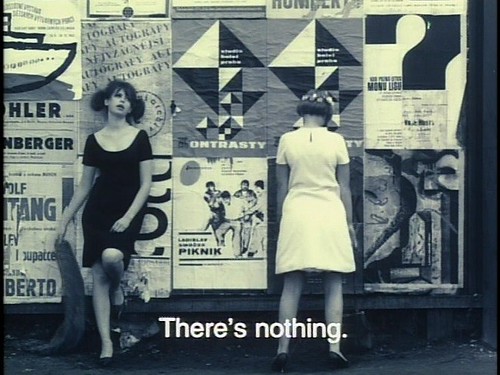
I mean the all of Daisies is incredible, but that foodfight scene is fucking phenomenal.
High up on the too-be-watched list is Fruit of Paradise. The color saturation is o.o.c like idyllic backgrounds oozing greens and browns with long-hair and titties everywhere.
There are a lot of beach party scenes too!


I cannot wait to see Prefab Story from '79. Comments on urban planning!
Plus in looking up the complete list of Chytilova's work I started reading about Juraj Jakubisko's work. WOW OH WOW.
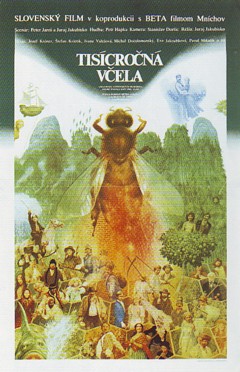
He made a saga using the lifecycles and habits of a bee!? The Thousand Year Old Bee?


Plus these stills are from a movie from '69 where weirdos squat a church called Birds, Orphans, and Fools. Plus a new movie called Bathory(NOT the Swedish black metal band) about a Hungarian countess who supposedly bathed in the blood of young Slovak women AND is the most expensive movie in the history of Czech cinema! THIS IS WHAT I AM TALKIN ABOUT.
Anders was telling me about Svankmajer's Alice in Taxidermied Wonderland, Alice.


That one is gonna be on the list for sure.
Valerie and Her Week of Wonders -a freaky gothic about menstration!
There is a documentary called Pictures from the Old World from 1972 that looks so incredible.


And there's Forman too!
Do they eat popcorn in the Czech Republic?
Friday, May 29, 2009
Return of the Spiel
After going to the hottest hot tub I have ever been in, John and I stayed up til after the roosters crowed talking about where we are, as people, as culture, and the ideas that in describing our lives makes it both harder and easier to allow ourselves to go on living. I wrote this a year ago today. What's funny is that I think about these conclusions and what lead me there everyday - absolutely.
****************************************************
In this form of relational art, the art becomes not a form of relation but actually in continuous support of it. In these networks, the role of producer, artist, reader, publisher, curator, drinking buddy, musician and audience are constantly in flux. “This is what emancipation means: the blurring of the opposition between those who look and those who act, between those who are individuals and those who are members of a collective body” (Ranciere 279). By allowing for a continuous rotation of roles, where people’s positions do not become invested with cultural capital, these networks become the outgrowth and the breeding ground for the kinds of social engagements the members desire. By avoiding the situating of artist-as-teacher, these fluid relationships, where the status of creator is not fetishized, become the sorts of productive friendships and practices that do not take down the spectacle but get closer to providing what would come after it.
To make art that is not about exclusively reflecting the spectacle is not to deny its existence or further its hold necessarily any more than making art that does attempt to reflect a certain feature or moment in or of the spectacle. The reason the spectacle is a problem is not a moral one –it is not an a priori bad. It is the continuing cause of the impoverishment of life. Daily life, as we know, is what is at stake in the perpetuation of the spectacle. But what is less emphasized is that is the site of contestation as well. Thus the emphasis becomes about the relation between art and daily life.
We can return to the avant-garde to try to understand how to revolutionize more than the aesthetics of daily life, or we can examine the relation between our daily lives and the fulfillment of our desires. What does art give us? A privileged space potentially of criticality, of independent and intentional production. We get to make the things we want to make. We get to create the form of sociality we want to experience. This is at the heart of spectacle critique: sabotaging the impoverishment of life. The thwarting of spectacle is not achieved through hyper-critical discourse alone. It comes through a reengagment with production, with desires, with spaces. It doesn’t require fancy language or meta-anything. It does require simple, direct, and self-aware production. It requires an attempt to better one’s own life through a direct and collective engagement with the world.
This art has a politic. It is not on the same cultural and theoretical level as, say, Rirkrit Tiravanja’s work. It has an intended and enacted politic that is precisely local. An individual or small collective cannot -through art or anything else- overthrow systems of global capital and their nefarious effects. This doesn’t mean we have to give up. We can harness the power of art as a privileged zone of engagement –thinking, making, generating- to provide for ourselves a better possibility. We can work to enact these changes on a wider scale through intentionally created networks. While there is no massive toppling, there is still value in providing for ourselves the things we need and desire. This is endlessly more valuable than a meticulous reading about whether the use of spectacle is thwarting, serving or oblivious to the spectacle itself. By creating exhibitions, resources, and a culture of friendly, funny, and intelligent creation, people are able to forge new spaces for the kinds of work, relations and participation that they are seeking. No amount of writing about the social possibilities of Pad Thai could ever do that.
********************************************
I sometimes wonder what would happen if I kept writing.
****************************************************
In this form of relational art, the art becomes not a form of relation but actually in continuous support of it. In these networks, the role of producer, artist, reader, publisher, curator, drinking buddy, musician and audience are constantly in flux. “This is what emancipation means: the blurring of the opposition between those who look and those who act, between those who are individuals and those who are members of a collective body” (Ranciere 279). By allowing for a continuous rotation of roles, where people’s positions do not become invested with cultural capital, these networks become the outgrowth and the breeding ground for the kinds of social engagements the members desire. By avoiding the situating of artist-as-teacher, these fluid relationships, where the status of creator is not fetishized, become the sorts of productive friendships and practices that do not take down the spectacle but get closer to providing what would come after it.
To make art that is not about exclusively reflecting the spectacle is not to deny its existence or further its hold necessarily any more than making art that does attempt to reflect a certain feature or moment in or of the spectacle. The reason the spectacle is a problem is not a moral one –it is not an a priori bad. It is the continuing cause of the impoverishment of life. Daily life, as we know, is what is at stake in the perpetuation of the spectacle. But what is less emphasized is that is the site of contestation as well. Thus the emphasis becomes about the relation between art and daily life.
We can return to the avant-garde to try to understand how to revolutionize more than the aesthetics of daily life, or we can examine the relation between our daily lives and the fulfillment of our desires. What does art give us? A privileged space potentially of criticality, of independent and intentional production. We get to make the things we want to make. We get to create the form of sociality we want to experience. This is at the heart of spectacle critique: sabotaging the impoverishment of life. The thwarting of spectacle is not achieved through hyper-critical discourse alone. It comes through a reengagment with production, with desires, with spaces. It doesn’t require fancy language or meta-anything. It does require simple, direct, and self-aware production. It requires an attempt to better one’s own life through a direct and collective engagement with the world.
This art has a politic. It is not on the same cultural and theoretical level as, say, Rirkrit Tiravanja’s work. It has an intended and enacted politic that is precisely local. An individual or small collective cannot -through art or anything else- overthrow systems of global capital and their nefarious effects. This doesn’t mean we have to give up. We can harness the power of art as a privileged zone of engagement –thinking, making, generating- to provide for ourselves a better possibility. We can work to enact these changes on a wider scale through intentionally created networks. While there is no massive toppling, there is still value in providing for ourselves the things we need and desire. This is endlessly more valuable than a meticulous reading about whether the use of spectacle is thwarting, serving or oblivious to the spectacle itself. By creating exhibitions, resources, and a culture of friendly, funny, and intelligent creation, people are able to forge new spaces for the kinds of work, relations and participation that they are seeking. No amount of writing about the social possibilities of Pad Thai could ever do that.
********************************************
I sometimes wonder what would happen if I kept writing.
Saturday, May 23, 2009
talents
It was on the Santa Cruz boardwalk that I finally found something I am good at!


It should not come as a surprise that it was dog themed. 245 tickets, baybee, in a single game. If only I could pay my rent in arcade tickets.


It should not come as a surprise that it was dog themed. 245 tickets, baybee, in a single game. If only I could pay my rent in arcade tickets.
Thursday, May 21, 2009
I'M HAPPY I'M RELAXED
also, i have a new house in the city. at divis and hayes, across from the popeyes, in a real victorian. it's practically on the wiggle, so stop by.
I'M MAKING IT.
Monday, May 11, 2009
FOR THE BIRDS
Pale Hoarse at the Marin Headlands from rebecca giordano on Vimeo.
Pale Hoarse played at the Marin Headlands on mother's day. At the top of a hill, marked by a giant white diamond courtesy of Chris Duncan, Kyle and Kim played in an echo cavern with bird calls and lights refracting through.
Did you know that magic has to happen in a time and a place and sometimes that time and place is the magic?
Subscribe to:
Posts (Atom)
